

Edituri /Promotii
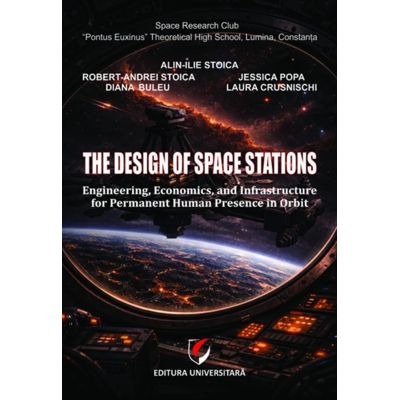
-The design of space stations. Engineering, economics, and infrastructure for permanent human presence in orbit - Robert-Andrei Stoica
DESCRIERE
Humans landed on the moon on July 20th, 1969. The first crewed mission, the International Space Station (ISS), was in the 2000s, and ever since the ISS has provided deep insights on human health, in-space manufacturing using 3D printers, and pharmaceutical manufacturing for the last 26 years. At the time the ISS was launched the cost of launching was $357000/kg. Given privatization and technological development in the last 10 years of in-space launching, the cost of shipping materials into low earth orbiting, (location of the ISS) has dropped to $2000-3000/kg range. Although space settlements that allow permanent living of humans in space require large components and heavy structures, given the historical price drop of launching and technological development of manufacturing using 3D printing, many of the components can become lighter and still meet the load requirements. While in the 70s, Gerard O’Neill was a visionary of space colonization into orbiting space stations, at that time, it might have looked nearly impossible because of the extremely high expenses, and the technological readiness level was much lower. However, nowadays, this matter has changed. We believe humans are near the point of reaching for the stars, reaching to live in space, more specifically in the low earth orbiting. While it is still relatively expensive for a private company to build a station, with costs in the tens of billions of dollars to build a large space station, the space industry is opening up everywhere from tourism, research, AI data centers, in-space manufacturing for pharmaceutics in microgravity and more. Even sports could be played in microgravity to allow football teams to compete in space enhancing tourism and the sports industry. Sports in microgravity and people watching from home microgravity football could be a product that is similar to how Steve Jobs envisioned a computer for everybody, a touchscreen smartphone, or tablets. These are products that humans don’t know exist but actually want them. All of these evolving opportunities appearing in space set a new stage for human space settlement as they become streams of steady revenue. While hard to notice, the space industry market has grown significantly in the last few years, especially in the commercial sector. We anticipate that the space market will soon start to grow exponentially as more startups join this industry. And a space station that hosts permanent residents could help contribute to this growth.
Establishing permanent bases on Mars, Moon, and low earth orbiting would allow for the development of trade routes which can be supplied from Earth with large warehouses on the space stations. Refueling of rocket ships can also be achieved on space stations as more fuel can be stored safely there. Starting with a space settlement in low earth orbiting, allowing humans to permanently live in space, is the beginning of a new era for the space industry, and it is anticipated to be just even larger than the satellite industry once the Earth-Mars and Earth-Moon routes are established. A company that designs and builds space stations has the potential of reaching values in the trillions of dollars over the next 30 years, just by capturing a fraction of the total market alone.
To build such large space settlement, many components and materials are used. These are manufactured on earth and increase the demand for materials. As with many industries, once a market is started, more companies will be formed in the same industry and the competition will be higher, allowing for even more innovation and technological development. All of these present the potential of a dramatic increase in the job market for many disciplines, creating thousands if not hundreds of thousands of jobs not just in engineering and research, but many more disciplines, including mining, manufacturing, artificial intelligence, technical assembly, robotics, sports, tourism and more. And it would even allow for enhanced training of astronauts in space. As they can be trained on the space station while living with their families in the same place.
Observing the technological readiness level to improve dramatically in the last 10 years, cost reductions in payload launching into low earth orbit, and significant market growth in space, the time for permanent human’s space settlement has come. While a space station was thought of purposely built for research, now with the current technology, a space settlement should be thought about it this way: “humans can live in a remote place, but they need the infrastructure. And once humans establish a place, a city, it becomes a trading opportunity for many businesses and opens the market”. They just need the infrastructure to live there. And the purpose of this book is to demonstrate that a large space station with permanent inhabitation capabilities can be achieved with the current state-of-the-art technology.
Titluri de aceiași autori


Promotiile Lunii
-
Cărţi noi
- 220,00 leiPRP: 250,00 lei (-12%)
 56,00 lei
 90,20 leiPRP: 110,00 lei (-18%)
Promoţii
-- 220,00 leiPRP: 250,00 lei (-12%)
- 90,20 leiPRP: 110,00 lei (-18%)
 62,99 leiPRP: 69,99 lei (-10%)


RECENZII