
Edituri /Promotii
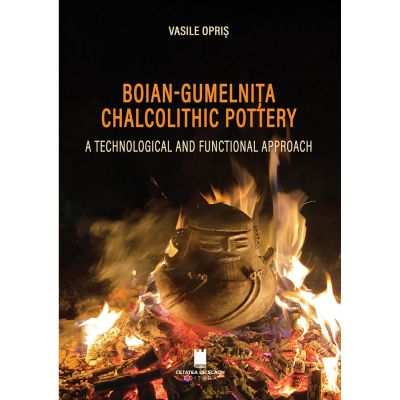
-Boian Gumelnita chalcolithic pottery. A technological and functional approach - Vasile Opris
DESCRIERE
This volume, Boian-Gumelnita Chalcolithic Pottery. A Technological and Functional Approach is much more than a reworking of a doctoral dissertation. It is the result of a long and coherent research trajectory, pursued with seriousness, intellectual curiosity, and methodological consistency over many years. Based on his doctoral thesis (2017), Vasile Opris has now published an updated English version of this book, which brings together the results of his sustained investigations into Chalcolithic pottery technology, archaeometry, functionality, and experimental archaeology, developed within several research projects.
I have known Vasile Opris since 2008, when he first joined the Sultana excavation. From the start, he combined patience, precision, and genuine enthusiasm. These qualities have deepened through fieldwork, careful study of materials, and a persistent interest in questions beyond traditional ceramic analysis. For over 15 years, he has been a leader in prehistoric pottery studies in Romania.
What distinguishes his work is not only his choice of subject but also his approach. In a research tradition that has often treated pottery mainly as a chronological or typological marker, Vasile Opris consistently seeks to understand it as a complex social and technological product. His studies go beyond form and decoration to address the chaine opératoire of ceramic production, including choices in clay selection and tempering, vessel forming techniques, surface treatments, firing conditions, and the intended and actual uses of pottery. In doing so, he contributes to a broader understanding of the human communities that produced and used these clay objects during the 5th millennium BCE.
Another major merit of this volume is its methodological openness. It unites archaeological observation, contextual and stratigraphic analysis, archaeometric investigation, and experimental archaeology in a productive way. This combination is not merely formal; it reflects a genuine effort to link the archaeological record with analytical methods that test hypotheses and refine interpretations. Such integration is essential today, especially in prehistoric archaeology, where reconstructing past technologies and practices depends on ongoing dialogue among fieldwork, laboratory science, and experimental replication.
The author’s familiarity with Boian and Gumelnita materials gives this work a solid foundation. These aren’t distant case studies, but contexts understood through direct, prolonged engagement. This closeness to the evidence is clear throughout. Analyses are grounded in experience, repeated observation, and deep knowledge of the Lower Danube Chalcolithic framework. Yet the discussion always situates local data within a broader regional and theoretical context.
For all these reasons, this volume deserves reading as an important contribution not only to Balkan Chalcolithic pottery studies but also to the broader archaeology of technology. It offers valuable data, careful analyses, and thoughtful interpretations. More importantly, it captures the intellectual growth of a researcher who has built his profile through serious work, interdisciplinary openness, and full commitment to archaeological inquiry.
I welcome this book as an exemplary model of how rigorous fieldwork, analytical ambition, and methodological balance advance our understanding of Chalcolithic communities north of the Danube. Specialists in prehistoric archaeology, ceramic studies, archaeometry, and experimental archaeology, as well as early-career researchers and students, will find in this volume a significant milestone in Vasile Opris’s scholarly career and a timely resource for their research.
Titluri de același autor

Promotiile Lunii
-
Cărţi noi
- 142,50 leiPRP: 150,00 lei (-5%)
 44,00 lei
 88,00 leiPRP: 110,00 lei (-20%)
Promoţii
-- 142,50 leiPRP: 150,00 lei (-5%)
- 88,00 leiPRP: 110,00 lei (-20%)
 48,30 leiPRP: 69,00 lei (-30%)


RECENZII